by Josie Fraser, Researcher & Writer for the Highland Good Food Partnership
For over a century now, most systems, including farming, have been operating on a linear economy: one that takes from the Earth’s resources and gives little back. This is evidently detrimental and is having seriously negative impacts on the planet. So how can it be done differently? Green Grow Foods, a mushroom micro-farm on the east coast of the Scottish Highlands are demonstrating exactly how. To find out more, I spoke to co-founder and ‘serial inventor’ Iain Findlay.
Green Grow Foods was created by Aurora Sustainability Group, a consultancy company founded by Iain and business partner Dr Isabella Guerrini de Claire. Aurora Sustainability helps other companies to build sustainable business models which incorporate the concept of circular economy and clean technologies. Circular economies focus on decoupling economic growth from over-consumption through continual use of resources, but more on that later. Set up to show their consultancy clients what a regenerative, smart farm business operating a circular economy looks like, Green Grow Foods took on a life of its own and is now a multi-award winning, zero-waste and cruelty free mushroom cultivator.
 Co-founders of Green Grow Foods: Dr Isabella Guerrini de Claire and Iain Findlay.
Iain tells me, “I got really interested in how much mushrooms can do in restoring land for forestry, people’s health and more, it’s amazing!” Indeed, the potential of mushrooms is amazing, and not yet fully explored. Mushrooms have an array of health benefits as they are packed with proteins, vitamins and antioxidants, making them a perfect ingredient in a healthy diet. With experimentation and combined skills and knowledge, the team at Green Grow Foods are exploring this potential of mushrooms to make vegan food and drinks, and have already created a mushroom-based hot chocolate!
Green Grow Foods are also making it easier for people to access and cook with this special ingredient by offering delivery of their Mushroom Meal Box and providing recipe ideas on their website. This is especially helpful for those wacky-looking mushrooms like the lion’s mane that people aren’t sure how to tackle!
 Some of the beautiful mushrooms cultivated by Green Grow Foods. On the right is the dazzling lion’s mane.
What is a circular economy?
Iain tells me that if you ask someone what a circular economy means, you might get a different answer depending on what industry that person is in. So what is his definition? “A circular economy basically mimics nature where everything is designed to be reused and remanufactured. It is the opposite of a linear one; a product of capitalism where you take something out of the ground, use it and then throw it away. These systems completely disregard the fact that the resources are finite and the consequences are over-use, decline in size and quality of products, running out of resources and polluting the environment.”
He continues, “Circular economies are really all about doing away with the concept of waste. Waste doesn’t exist in nature. There is value in what we call food waste – we just need to find other ways to extract this value which is exactly what mushrooms do! Cardboard and straw, which look like they have little value, can be turned into the high value product of mushrooms. The process requires thought and imagination [instead of mindless extraction]. It’s about understanding that you can’t keep taking from the soil without putting something back, and that where there is waste, there is value.”
If all businesses adopted a circular economy approach, a lot of the issues of sustainability would be solved. Iain says, “If we don’t switch to circular economies, then solving these issues won’t happen. It’s physics. The first and second laws of thermodynamics make it inevitable: we just can’t keep taking from the Earth without putting something back.” He adds, “The potential to improve everything is mind blowing. Everything needs to be reimagined and redesigned.”
How are Green Grow Foods demonstrating a circular economy?
Green Grow Foods grow their mushrooms inside repurposed and refurbished shipping containers. These containers are heated by pipes which carry left-over heat from a neighbouring distillery. This source of heat would typically be lost, but instead with some imagination, it has been redesigned as a valuable resource for the growing of these mushrooms. Iain adds, “Growing in containers enables us to control the environment, which allows us to get the most out of the growing cycle. They are sealed so you can manage humidity and temperature easily. This helps extend the growing season and protects the mushrooms from being eaten by other animals.”
Instead of growing in soil, the team uses discarded coffee grounds which are collected from cafes nearby, and spent grains from local distilleries; resources that would otherwise be tossed in the bin. The buckets that the mushrooms grow in are also repurposed as they are obtained from a local bakery that no longer requires them.
 Mushrooms growing in stacked repurposed tubs inside the shipping container.
After a six-week growing cycle, the mushrooms are sold to local restaurants or dehydrated and sold in meal packages. The remaining mushroom compost continues its useful life and is used in environmental projects such as forestation where it is a highly-valued resource.
By using ‘waste’ products that are abundant in their local area, this revolutionary system enables Iain and the team to create top quality products without putting any more demand on the Earth for her precious resources.
Examples of this closed-loop system, where the byproduct of one stage is fed back into the system for the creation of another product, can be found elsewhere in farming. One such example seen across America is in cattle rearing and this is how it works: the cattle eat crops and produce manure which is collected and put into a digester. There, it is turned into a liquid. Methane is released in the process and is transformed into biogas which can be used to power the home, barn or farm vehicles. The liquid that is left is used as a fertiliser for the crops, including those that feed the cattle. Fibres which are left at the end of the digestion process can be used as bedding for the cattle, potting soil or compost. This is just one example of the various ways manure is used on the farm in a closed-loop or circular economy system, but it just goes to show how inspiring circular economies are, and how ambitious designers can be when they create them. Who would have thought cattle could provide farmers with energy independence?
Supporting others
Iain tells me, “The idea is that our process is replicable. With containers, you can scale up or down very easily by adding or taking away a container.” He adds, “Little bits of industrial sites all over the country could have three, four, five shipping containers that are all coming from China and not going back.” With the small area required for a shipping container and growing with cheap resources that are abundant in your local area, this model of growing can provide a great opportunity to others. The team at Green Grow Foods make themselves available to help others replicate their micro-farming and circular economy model, and are currently in talks with a group in Edinburgh looking to create something similar.
Keen to pass on its innovative solutions, Green Grow Foods provides the technology and skills to get others started in both urban and rural areas. The team has also created Europe’s first mushroom open-lab concept which supports other fungi startups by providing knowledge as well as technology and marketing help.
But the company’s commitment to lend a helping hand doesn’t end there. The team provides further community support by offering to buy and then sell in their meal packages the mushrooms from other fungi fanatics nearby. Iain explains, “Lots of growers just like growing but not the selling side. By buying from others it creates a market for people to grow and gives them a bit of stability to do it.” This is a way of de-risking farming for others and creating connections with other growers, which Iain tells me they are very interested in.
So what’s next for a company like this?
Green Grow Foods are currently developing, in collaboration with other companies, fungi-based packaging as a sustainable alternative to what already exists. The packaging will be made from mycelium – the ‘roots’ of the mushrooms – and they have hopes that they can even create a product that will be edible for marine life! This would definitely tick boxes for conservationists in the fight against the plastic tide.
Green Grow Foods also hopes that in the future it can run reforestation projects and transform degraded land, such as landfill sites, by using the magic of mushrooms to support new growth.
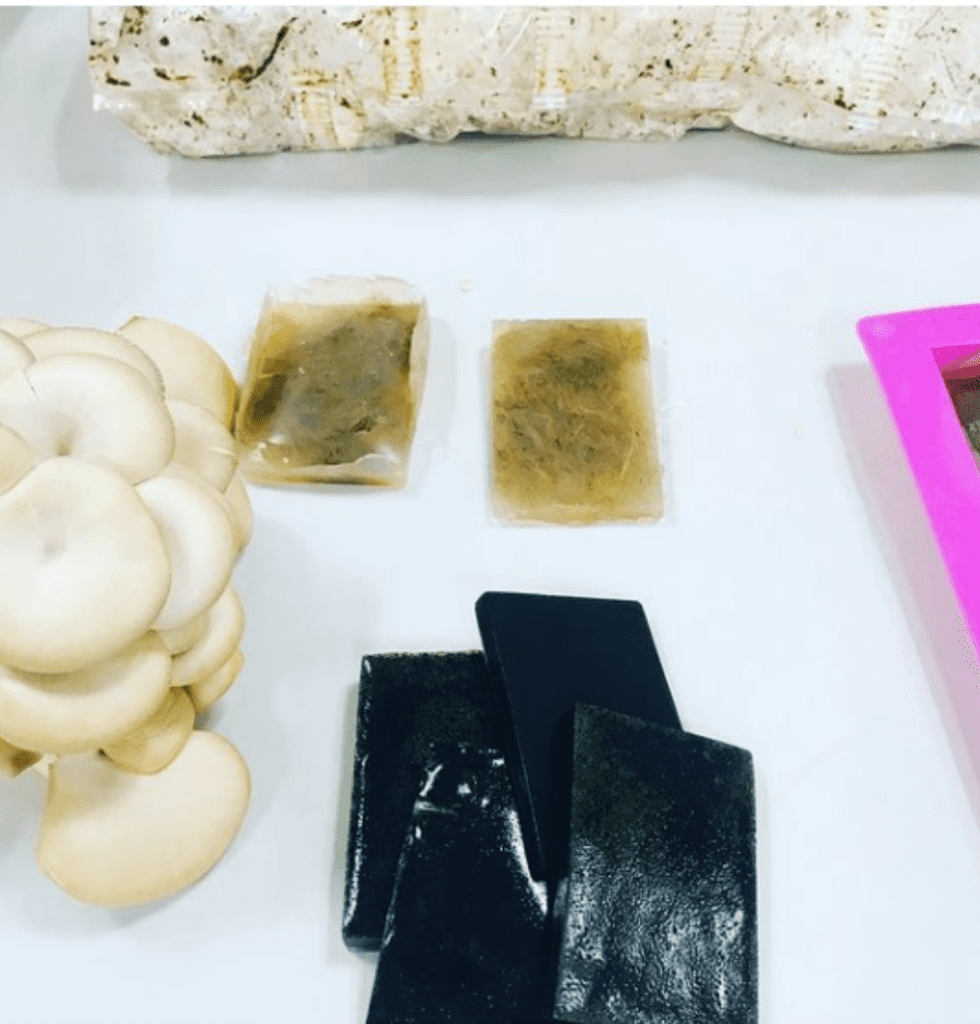 Samples of Green Grow’s biomaterials made with mycelium and hemp.
A vision for the future
Like many of the other people we speak to, what comes to Iain’s mind first when I asked what a good food system looks like for him, he responded, “One where food producers get paid properly. A system where they are paid for the quality that they produce.” His vision goes further, “I would like to see more opportunity for people to access food and a bit more imagination about how to achieve that, including face to face contact. As well as better education on the importance of supporting local growers and for people to know what happens to food waste.” He continues, “There should be more access to land and discussions about land ownership. And finally, a lot more being done in schools.”
Green Grow Foods is an inspiring example of a good food system where resources previously thought of as waste are being revalued and proving that their useful life goes far beyond that for which they are often used. A circular economy model is about smart connections, building communities and stopping the tragic degradation to the planet, something that its out-dated opposite has been doing for too long.
What an empowering way to do business!
To find out more about Green Grow Foods and their projects, click here: https://www.greengrowfoods.shop/