Sunshine, Shetlands and Shared Knowledge: Our First Farmer Cluster Connections Walk
by Ele Forster
Friday 13th was lucky for us as crisp, cold sunshine welcomed us to Carol Williams’ small farm near Muir of Ord. We were also fortunate to have James Yoxall from Grampian Graziers join us to bring his expertise to our first Farmer Cluster Connections farm walk.
The driving idea behind the Farmer Cluster Connections project is that within our farming and crofting communities is a wealth of knowledge and experience. Much of farming is done in isolation, and there’s huge value in providing a space for producers to gather together to share knowledge, explore solutions and support each other.
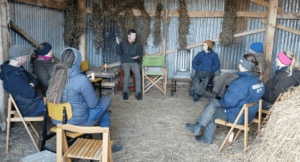
This concept was proven within minutes of pouring the coffee: conversations were flying and strangers were discovering common ground. Once we had everyone sat beneath Carol’s bundles of birch tree hay, we discovered our group had a range of place, size and focus of farms.

James brought us back to the basic principles of regenerative farming:
- Minimise/optimise soil disturbance
- Keep the soil covered
- Maintain living roots year-round
- Maximise diversity
- Integrating livestock
There is some criticism of ‘regenerative agriculture’ as too wooly a term, but there’s also a strength in a concept that allows farmers to build their soil health in a myriad of ways, that works within their own unique circumstances. There is no end point.
We were pleased to get moving and into the sunshine, wandering down to see Carol’s Shetland cows. This being our first farm walk, I was worried that we’d run out of farm and conversation in the hours before lunch, but it turns out there is endless interesting discussion to be had in a field with some farmers, a few cows and a cat.
Topics ranged from calving times, parasite management, gorse, water trough positions, abattoir regulations, electric fence use, shetland physiology, gut bacteria, tree planting, rushy ground, dealing with snow all the way to discussing being able to handle a bull armed with just a bit of white string. It was clear how useful it can be to have a chance to explore issues together, from the macro (climate change) down to micro (a recommend for a particular brand of water trough valve).
As a non-farmer, I was blown away by how knowledgeable and innovative our attendees are, and how generous they were with their experience. It’s heartening hearing about their hard work and dedication in the face of difficult economic and environmental conditions – doing their very best by the animals and land in their care – but also sad to hear how much of a struggle it can be, especially in isolation. We really hope the Farmer Cluster Connections project can help link farmers and crofters up across the Highlands to increase support.

Our flapjacks had worn off, and the warmth of Carol’s kitchen was very welcome as we tucked into an epic pot of soup. A discussion around the Farmer Cluster Connections project followed after lunch, along with a taste of honey from Carol’s husbands’ bees.
This project is farmer-led. We have secured funding for farm walks, speakers, webinars and gatherings. Although there are 8 regions running concurrent Farmer Cluster Connections projects, we have the freedom to develop it in the way that brings the most value to Highland crofters and farmers. Some smaller geographic and interest-based clusters are evolving, and there also seems to be a desire to be able to connect with other producers across the Highlands who are trialling and learning about regenerative agriculture.
Huge thanks to Carol for being such a welcoming, open host. We’re excited to see what this year brings us!
If you’d like to be involved, check out the Farmer Cluster Connections page here.